
What Fire Damage Does to Attic Insulation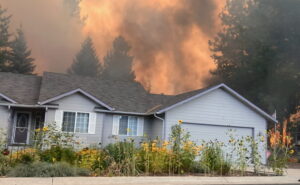
The attic is designed to pull smoke in. This is the part homeowners don’t expect. A properly ventilated attic moves air continuously — in through the soffit vents at the eaves, out through the ridge or roof vents at the peak. During a wildfire event, that system does exactly what it was built to do, except what it’s drawing in is smoke, soot, ash, and airborne combustion byproducts.
A home doesn’t have to burn to have a contaminated attic. Homes miles from the burn area pull smoke through their ventilation system for as long as the smoke sits over the area, which during a major event can be days.
Insulation acts as a filter
Attic insulation is porous by design — that’s what makes it insulate. Those same air pockets capture and hold particulate.
Fiberglass traps soot and ash within the fiber matrix. Surface deposits may be visible as gray discoloration, but a significant portion of the particulate works down into the batt or blown layer where it can’t be seen or reached.
Cellulose is worse. It’s treated paper, and it’s highly absorbent. It takes on both particulate and the volatile
organic compounds that carry smoke odor, and it holds them.
Mineral wool behaves similarly to fiberglass, with particulate lodging in the fiber structure.
In every case, the insulation becomes a reservoir. The contamination isn’t sitting on top waiting to be wiped off — it’s distributed through the material.
Odor is a chemical problem, not a surface one
Smoke odor comes from VOCs and semi-volatile compounds that adsorb onto and into porous materials.
They don’t simply dissipate. Two conditions reactivate them: heat and humidity. That’s why homeowners often report the smell seeming to fade, then returning strongly on the first hot day of the following summer, or during a humid stretch. The attic heats up, the compounds volatilize, and the odor comes back into the living space.This is also why odor is a recurring source of claim disputes. An inspection in cool weather may find nothing remarkable. The same attic in August tells a different story.
Soot residue can be chemically active
Smoke from a structure fire or a mixed-fuel wildfire contains more than wood ash. Burned building materials, vehicles, plastics, treated lumber, and household contents produce residues that can be acidic and corrosive. In an attic, that matters beyond the insulation itself. Acidic residue settles on metal — truss plates, fasteners, HVAC components, ductwork, electrical boxes, and the underside of the roof deck. Corrosion from fire residue is a documented phenomenon, and it progresses after the fire is out.
Why you usually can’t clean it in place
HEPA vacuuming removes surface deposits and loose particulate. It does not remove contamination that has worked into the body of the material, and it does not address adsorbed VOCs.
For that reason, the standard remediation approach for contaminated attic insulation is removal and replacement, not cleaning. The accepted sequence is generally:
- Containment and negative air to protect the living space
- Removal of the existing insulation
- HEPA vacuuming of the attic cavity — joists, top plates, deck underside
- Cleaning and, where warranted, sealing or encapsulation of framing surfaces
- Air sealing of penetrations
- Installation of new insulation to the specified R-value
Skipping to step 6 — blowing new insulation on top of contaminated material — traps the problem rather than solving it. The odor source stays in place, now buried.
Related damage worth checking
Water and retardant. If the structure was wetted during suppression, or if retardant drift reached the roof and entered the attic, insulation may be compacted, wet, or chemically affected. Wet insulation loses R-value and doesn’t fully recover, and prolonged moisture in an attic creates a mold risk independent of the fire.
Compaction. Insulation that has been soaked and dried, or disturbed by crews working in the attic, loses thickness and therefore loses R-value.
Ember intrusion. In a severe event, embers can enter through vents. Look for scorching, char, or melted areas near soffit and gable vents — localized damage that indicates how much got inside.
Why this gets missed in claims
Attics frequently aren’t inspected during a fire claim. There’s no obvious damage from the ground, no visible loss, and the adjuster may never go up. The result is a settlement that covers what was visible and leaves the contaminated insulation in place. The homeowner finds out the following summer, often after the deadline for supplementing the claim has passed.
A few points worth documenting at inspection:
- Photographs of the insulation surface, including close-ups of any discoloration
- Documentation of soot at soffit and ridge vents, which demonstrates the intake path
- Photos of the roof deck underside and any metal components showing residue
- Notes on odor conditions, including ambient attic temperature at time of inspection
- Where available, laboratory analysis of a sample for char and ash particulate — this is the strongest documentation when a carrier disputes causation
The short version!
If there was significant smoke in the area, your attic breathed it for as long as the smoke lasted. The insulation up there is porous, and it holds what it catches. You may not smell it today. You very likely will on the first hot day next summer. Have our team of professional inspect your home!